
The Origins of Christmas Traditions
It is tempting to think that our festive traditions have been with us since forever, but they evolve and change with time. Some are even far newer than you might think.
The Christmas Tree
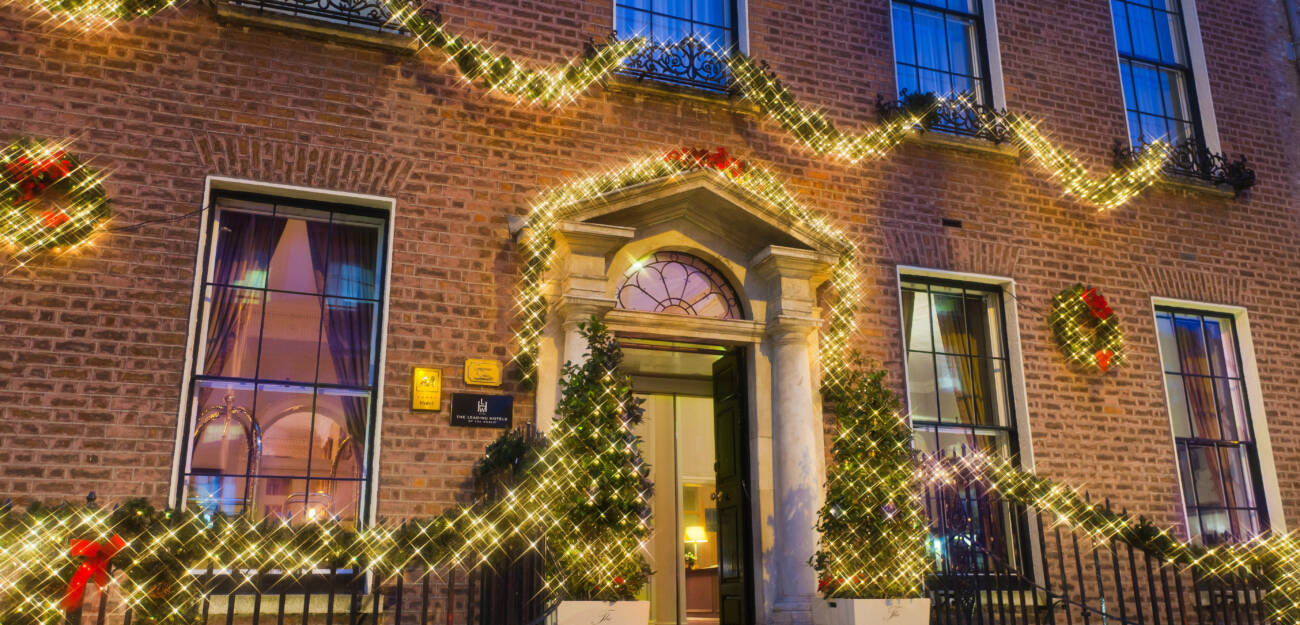
We are changing our traditions at The Merrion Hotel this year, by switching to a forever Christmas Tree in support of our commitment to sustainability, but where did the practice of bringing evergreen trees indoors at this time of year come from? Evergreens, in the form of trees, garlands and wreaths have been used to symbolise enduring life across time, dating back to Ancient Egyptian, Chinese and Hebrew cultures. Our more modern Christmas Tree comes from Germany. First featuring as a prop in a Medieval play, it represented the Tree of Paradise in the Garden of Eden, and would be set up in homes on Christmas Eve. It came to these parts in the Georgian era, when Queen Charlotte, wife of George III brought the custom from her native Hanover, which means there could well have been a tree in the Merrion’s Drawing Rooms back in 1800, although they didn’t become widespread until an engraving of Queen Victoria, Prince Albert and the royal children around their family Christmas Tree was published in 1848 in the Illustrated London News, making trees all the rage among the fashionable classes.
Christmas Lights
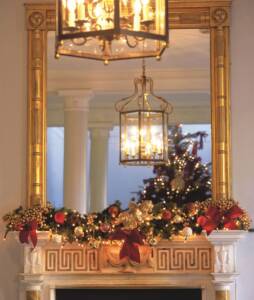
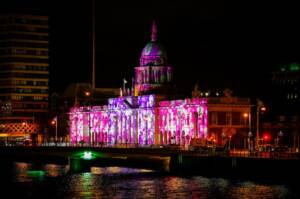
For hundreds of years, Christmas was a candle-lit affair, and while we still love candles at this time of year, Christmas lights have come a very long way – as Dublin’s Winter Lights Festival proves. Buildings, bridges and artworks are lit up around town, and there is a special and magical illuminated wonderland in our neighbouring Merrion Square Park. Back in 1879, Thomas Edison demonstrated his new light bulb, and just three years later, his friend and associate Edward Johnson showed off the first string of lights to adorn a Christmas Tree. Eighty red, white and blue lights had been hand-wired together, and displayed at his home on New York’s Fifth Avenue. At first considered a gimmick, they were quickly seen as a much safer alternative to candles on the trees! By 1890, they were available for sale, but were so expensive that in 1903 in the US, General Electric had sets for rent. Those of us of a certain age will remember how tricky the older strings of Christmas lights were to repair, as just one faulty bulb would cause the whole lot to fail. Today’s LED lights solve that problem, beautifully.
The Yule Log
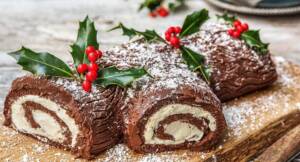
Not all family homes have fireplaces these days, which makes The Merrion Hotel’s crackling log fires all the more welcoming as the colder weather comes in. The Yule Log is actually one of our oldest seasonal traditions, dating right back to Pagan times, when logs burned brightly during the longest night of the year. Older Christmas practices included burning a portion of the log each night until Twelfth Night on January 6th, and then keeping the last piece under the bed throughout the year for luck, and to light next year’s log, in a lovely symbol of continuity. These days, those without a hearth at home, can opt for a nod to the tradition with the chocolate version as a sweet reminder of the custom.
Christmas Jumpers
Many might prefer if the Christmas Jumper tradition could quietly fade away, and in its current form it’s pretty new. With origins in traditional Nordic knitted patterns that included animal, plant and snowflake motifs, the rise of skiing holidays in the 1920s popularised the patterns away from the slopes. Nordic knits were worn by famous film stars, including Clark Gable and Ingrid Bergman, but the more ridiculous Christmas versions gained even more mainstream popularity after singers, celebrities and comedians from began to wear them, including Val Doonican and Gay Byrne in the first ever Late Late Toy Show in 1975. Once Colin Firth popped up in one as Mark Darcy in 2001’s Bridget Jones’s Diary, there was no turning back. In recent years, anti fast fashion campaigns are encouraging us to give them a new lease of life, and Christmas Jumper Swaps are now a welcome feature of the pre Christmas preparations.

The Twelve Days of Christmas
The origins of the Twelve Days of Christmas song go back to an children’s book, titled, somewhat discouragingly, Mirth Without Mischief, and published in London in 1780. Since then, the song has had many variations, including in Ireland, Frank Kelly’s from an RTÉ broadcast in 1983, where the much loved late comedian describes the detrimental effects the gifting of all the birds, animals, drummers and dancing ladies have had on his previously peaceful life. In the US, the PNC Financial Services group have, for the past forty years, totted up the total costs of all that gifting. Last year the bill came to US$46,729.86 (approximately €43,000), but rose to a staggering $201,972.66 if you bought each gift every time it is mentioned. The most costly on that list? The ten lords a-leaping, closely followed by the seven swans a-swimming.
We think we’ll settle for the five gold rings, thank you very much. Wishing you a wonderful Festive Season, and all the pleasures of your favourite traditions – with maybe a new one or two to bring forward into a very happy New Year.