
In the name of Irish love
True love knows no boundaries, but is love the same the world over? With Saint Valentine’s day on the horizon, and celebrating lasting love all February long at The Merrion Hotel, we look at some particularly Irish traditions when it comes to showing your very sincere affection.
More than words
First of all, how do you say “I love you”? Those three little words directly translate into Irish as is grá liom thú, but when it comes to language, how we use the words has always mattered more. Traditionally, Irish speakers have brought a greater poetry to their declarations of affection, using phrases including tá mo chroí istigh ionat – “my heart is in you”, is tú mo ghrá – “you are my love”, and our favourite grá geal mo chroí – “bright love of my heart”. Now isn’t that, as the Irish would say, only gorgeous?
Not quite ready for the full declaration? Try a stór, or a rún – both mean “my darling”. Or try mo chroí álainn – “my beautiful heart”. Check out Enibas, for beautiful jewellery, hand made in West Cork, with messages in Irish engraved. Their Croí Álainn double pendant costs €188.

Put a ring on it
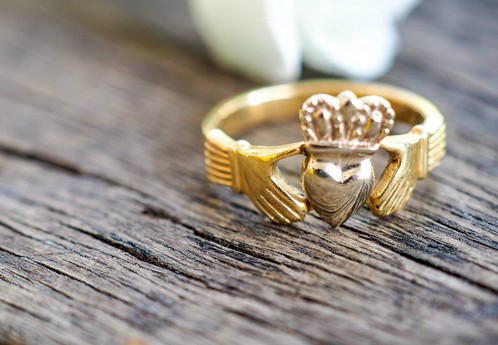
With its pair of hands, clasping a crown-topped heart, the Irish Claddagh Ring is famous the world over. Each element is said to symbolise an aspect of love: friendship, the heart, and loyalty. The design originated in Claddagh, County Galway back in the 1700s, and like all good legends, there are several stories attached. The most consistent one is connected to silversmith Richard Joyce who in 1675 was captured into slavery by Algerian pirates, who then sold him to a Moorish goldsmith. This proved to be a learning experience for Joyce, in more ways than one, and when he was at last released, he brought home with him the ring he had fashioned in captivity, presenting it to his steadfast sweetheart. His initials are to be found on one of the oldest surviving Claddagh Rings.
From Queen Victoria to J F Kennedy, John Wayne to Daniel Day Lewis, and Mia Farrow to Liam and Noel Gallagher of Oasis, Claddagh Rings have been seen on the fingers of kings and queens, politicians and the powerful, celebrities and stars. But did you know that where and how you wear yours sends a vital message? On the left hand, the heart pointing in means you’re married, while pointing out means engaged. On the right, heart pointing in towards your body means you’re in a relationship, but pointing out to the world means you’re still looking for your own true love.
February 29th
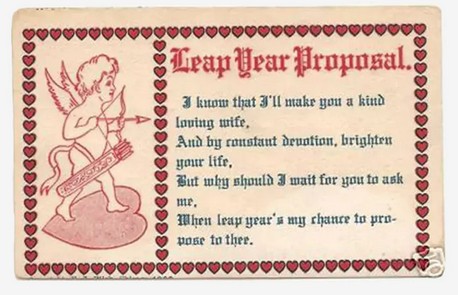
In the 2010 film, Leap Year, Amy Adams comes to Ireland on February 29th, because, according to tradition, that is the day women in Ireland were “allowed” to propose to their partners. In the way of romantic comedies everywhere, things don’t quite work out as planned, but true love conquers all. It’s quite a charming film, but where does the tradition itself come from?
Back in the 5th century, Saint Bridget, or so the story has it, took Saint Patrick to task, saying how unfair it was that Irish women went unwed, because their sweethearts were too slow to propose. It took a bit of haggling, but Patrick agreed to set aside one day every four years for female proposals. Rumours that the custom became law in Scotland are untrue, but the custom did prevail, and the penalty for a refusal was set at one silk dress. Now, you might think that enterprising Irish women might prowl the parish, requesting marriage after marriage, and amassing a new wardrobe in the process, but in fact they tended to play fair – most probably because you don’t mess with love, especially when Ireland’s patron saints are involved. You’ll have to wait for 2028 for the next Leap Year.
The Patron Saint of Love in Dublin
We couldn’t talk about love in Dublin without talking about the patron saint of lovers everywhere: Saint Valentine. The 3rd century Roman saint was said to have been martyred for conducting marriages against the wishes of the Emperor. More than one thousand years later, his relics were gifted to Irish Carmelite priest, Father John Spratt as a token of Pope Gregory XVI’s esteem, and today they reside in a chapel in Whitefriars Church on Aungier Street – you can read the full story on our dedicated blog, here.
Don’t go expecting baubles and trinket gifts in the adjacent shop, although replica statuettes of the saint are for sale. You are more likely to be moved by the quiet calm of the place, as this is a working church with Mass said daily. On February 14th, couples may go to have their rings blessed, and will pause to say a quiet prayer to lasting love – whether it is one of thanks, or delivered in hope is up to them!

Whatever you are hoping for, we wish you all the love and luck of the Irish this Valentine’s Day.